Headline
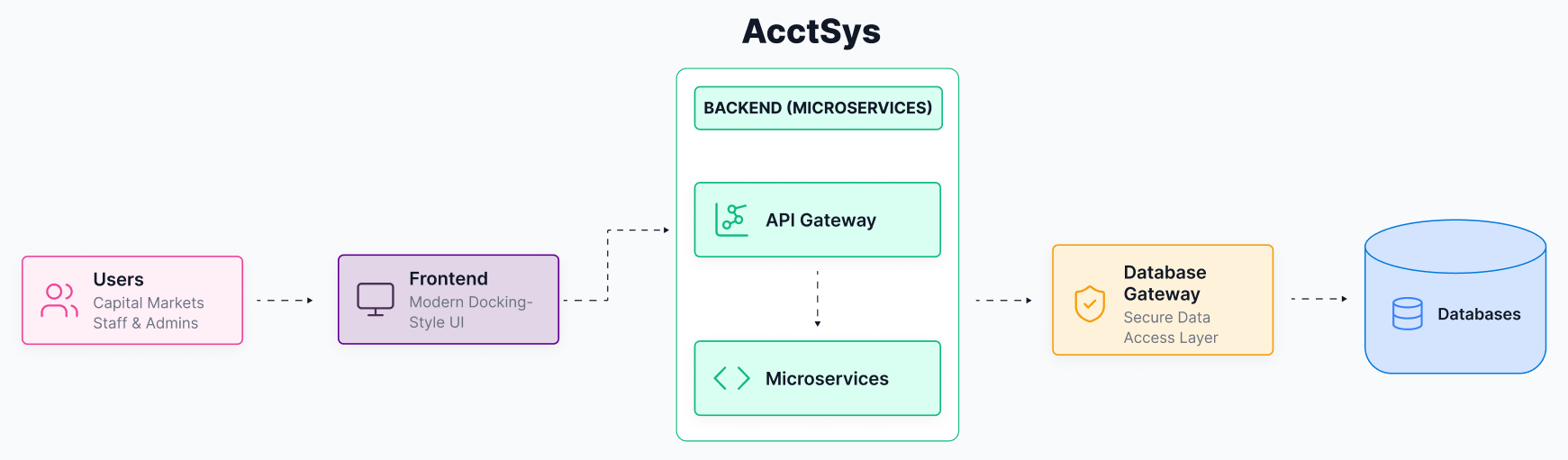
We modernized a decades-old VB6 banking application into a secure, browser-based application built on microservices. Every business rule was preserved, and the production database stayed completely unchanged. The rebuild ran screen by screen: analyze the legacy flow, map it to new services and UI, implement, then test against verified legacy behavior. AI assisted with legacy comprehension, boilerplate scaffolding and test coverage, with human-in-the-loop review gates.
What we built: Bounded services over the legacy data
Behavior rebuilt from code
We reconstructed user behavior entirely from the VB6 source, database scripts and screen references embedded in the code.
A traceable screen map
We mapped every legacy screen to its new UI and the service behind it. Unknowns were flagged early to avoid rework.
Bounded services and API contracts
The monolith was split into bounded services with clean separation between UI, API, business logic and data. Each service has a well-defined API contract, and a dedicated data-access layer safely wraps the legacy databases.
A schema copy to build against
We recreated the existing schema in our own environment to develop and validate against. Every new service preserves the original data contracts and behavior.
A familiar, clearer interface
The new interface is clearer and consistent, and it keeps the workflows and mental models users rely on. Screens are built from a reusable component library.
Security controls
Least-privilege access
Secure handling of secrets and configuration
Defensive input validation
Built-in auditability and traceability
How it works: A four-step pipeline per screen
Each legacy screen moved through the same pipeline:
Analyze the legacy flow.
Map it to target services and UI.
Implement the services and screens.
Test and regression-check against verified legacy behavior.
AI sped up comprehension of legacy modules, scaffolded translation boilerplate and broadened test coverage. Human-in-the-loop review gates kept accountability for logic, security and correctness.
We put an early working version in the client's hands quickly so they could explore, react and steer.
Technology: Stack and quality controls
| Starting point | VB6 banking application and its database scripts |
|---|---|
| Architecture | Browser-based application on microservices: UI, API, business and data layers |
| Interfaces | Well-defined API contracts per service |
| Data access | Dedicated layer wrapping the unchanged legacy databases |
| Front end | Reusable component library |
| Testing | Unit, API-contract, integration and regression tests built from verified legacy behavior, backed by code review, static analysis and a shared definition of done |
| AI assistance | Legacy comprehension, boilerplate scaffolding, test coverage, with human review gates |